Insertion Electromagnetic Flowmeter Supplier | CHHONE
Insertion Electromagnetic Flowmeter: An Efficient Solution for Large Pipeline Flow Measurement
Measuring liquid flow in large-diameter pipelines can be a challenging task for many industrial facilities. Conventional inline flowmeters may require significant installation space, pipeline modifications, and higher equipment investment, particularly in large-scale water transportation and industrial fluid distribution systems. To address these challenges, theInsertion Electromagnetic Flowmeteroffers a practical alternative for measuring conductive liquids in medium- and large-diameter pipelines.
Based on electromagnetic induction technology, an insertion electromagnetic flowmeter measures liquid velocity through a sensor inserted directly into the pipeline. Its compact measuring structure and flexible installation options make it suitable for various industrial applications, including water supply networks, wastewater treatment plants, cooling water systems, and industrial process pipelines.
For engineering companies, industrial equipment distributors, and end users, finding a reliableInsertion Electromagnetic Flowmeter Supplieris essential to achieving accurate measurement and stable operation. CHHONE is committed to providing professional electromagnetic flow measurement products and industrial instrumentation solutions for different pipeline configurations and operating conditions.
When Large Pipelines Need a Different Flow Measurement Approach
In industrial fluid transportation systems, pipeline diameter is an important factor when selecting flow measurement equipment.
For smaller pipelines, conventional inline electromagnetic flowmeters are widely used. However, as pipeline diameter increases, the installation and replacement of full-bore measuring instruments may become more complicated and costly.
Large water transmission pipelines, industrial cooling systems, municipal water distribution networks, and wastewater transportation facilities often require flow measurement solutions that can accommodate substantial pipeline dimensions.
An insertion electromagnetic flowmeter provides another option.
Instead of installing a complete measuring tube between two pipeline sections, the instrument uses an insertion-type sensor that extends into the flowing liquid. By detecting the local flow velocity, the instrument can calculate the average flow velocity and volumetric flow rate according to its calibration and measurement configuration.
This approach can reduce the amount of pipeline modification required and offer greater flexibility for certain large-pipeline measurement projects.
What Is an Insertion Electromagnetic Flowmeter?
An Insertion Electromagnetic Flowmeter is a flow measurement instrument designed to measure the velocity and volumetric flow rate of electrically conductive liquids inside a pipeline.
Its operating principle is based on Faraday's Law of Electromagnetic Induction.
When a conductive liquid moves through a magnetic field generated by the sensor, an induced voltage is produced. The magnitude of this voltage is related to the liquid velocity. The sensing electrodes detect the induced signal, which is processed by the electronic converter to determine flow velocity.
Unlike a conventional full-bore electromagnetic flowmeter, an insertion electromagnetic flowmeter does not require the entire pipeline section to be replaced by a measuring tube.
The sensor is inserted through an appropriate pipeline opening and positioned within the fluid. Depending on the product design, installation can be carried out through a dedicated mounting fitting, a valve assembly, or another suitable insertion structure.
The measurement result is influenced by the sensor position, pipeline geometry, velocity distribution, and calibration method. Therefore, proper installation and application-specific calibration are particularly important.
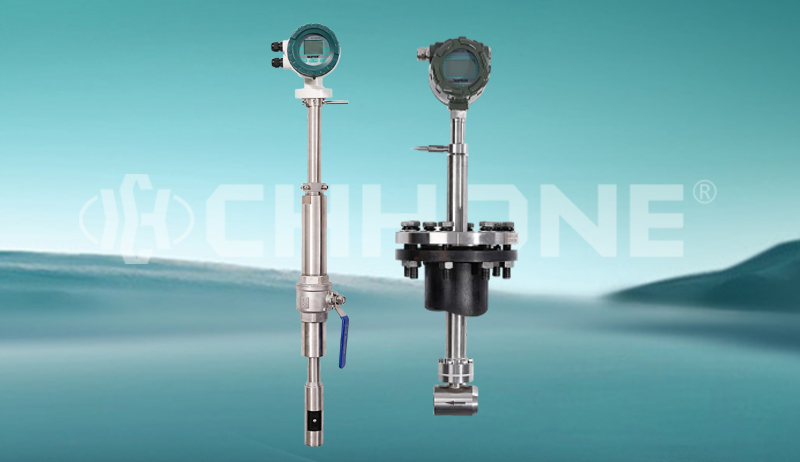
How Does an Insertion Electromagnetic Flowmeter Work?
Understanding the working principle helps users evaluate whether this technology is appropriate for their applications.
The measurement process can be divided into several stages.
1. Magnetic Field Generation
The sensor generates a magnetic field around its measuring electrodes. This magnetic field interacts with the conductive liquid flowing through the pipeline.
2. Electromagnetic Induction
As the liquid passes through the magnetic field, an induced voltage is generated in accordance with Faraday's Law.
The induced voltage is proportional to the liquid velocity under the specified sensor geometry and magnetic field conditions.
3. Signal Detection
The electrodes installed on the sensor detect the induced voltage. The electrical signal is then transmitted to the electronic converter.
4. Signal Processing
The converter processes the detected signal and determines the liquid flow velocity based on the instrument's calibration parameters.
5. Flow Rate Calculation
Once the average pipeline velocity is determined, the volumetric flow rate can be calculated using the pipeline cross-sectional area.
The basic relationship is:
Q = v × A
Where:
-
Q represents volumetric flow rate.
-
v represents average flow velocity.
-
A represents the internal cross-sectional area of the pipeline.
Because an insertion sensor measures velocity at a particular position or across a defined sensing region, the conversion from local velocity to average pipeline velocity must follow the instrument's calibration and measurement method.
This is an important consideration when selecting an insertion electromagnetic flowmeter for large-diameter pipelines.
Key Advantages of Insertion Electromagnetic Flowmeters
Insertion electromagnetic flowmeters offer several advantages for industrial users, particularly in applications involving large pipelines and conductive liquids.
1. Suitable for Large-Diameter Pipelines
One of the most important advantages is their suitability for large-diameter pipeline measurement.
In applications where installing a full-bore electromagnetic flowmeter would involve considerable pipeline modification, an insertion-type design may provide a more convenient alternative.
This makes it particularly attractive for water distribution networks, industrial cooling systems, and large-scale liquid transportation projects.
2. Flexible Installation Options
Insertion electromagnetic flowmeters are installed through a suitable opening in the pipeline rather than replacing an entire pipeline section.
Depending on the design, they may be installed using dedicated mounting fittings or valve-based assemblies.
Certain models are designed to support installation or removal under operating conditions when used with an appropriate hot-tap assembly and in accordance with the manufacturer's safety procedures.
3. Reduced Installation Requirements
For certain large-pipeline applications, insertion-type instruments can reduce the need for extensive pipeline reconstruction.
This may help simplify project installation and reduce associated engineering work.
However, the actual cost advantage depends on pipeline diameter, pressure conditions, mounting design, installation access, and the required measurement performance.
4. Minimal Flow Obstruction
The sensor occupies only a relatively small portion of the pipeline cross-section.
As a result, insertion electromagnetic flowmeters generally create less flow obstruction than some mechanical measurement devices.
This characteristic can be beneficial in applications where maintaining efficient liquid transportation is important.
5. Low Mechanical Maintenance Requirements
Electromagnetic flow measurement does not depend on rotating impellers or turbine components.
The absence of conventional moving measuring parts helps reduce mechanical wear and routine maintenance requirements.
6. Convenient Integration with Industrial Automation
Depending on the selected model, insertion electromagnetic flowmeters can be equipped with electronic converters, digital displays, and different signal output options.
These may include 4-20 mA analog signals, pulse outputs, and communication interfaces for connection to PLC, DCS, and other industrial control systems.
Such configurations support centralized monitoring and automated process management.
Where Are Insertion Electromagnetic Flowmeters Used?
Insertion electromagnetic flowmeters are particularly relevant to applications involving conductive liquids in medium- and large-diameter pipelines.
Their versatility makes them useful across several industrial sectors.
Municipal Water Supply and Distribution
Municipal water networks often contain large-diameter pipelines responsible for transporting water over long distances.
Insertion electromagnetic flowmeters can be used to monitor water transportation, distribution flow, and pipeline operating conditions.
They may also support flow measurement in pumping stations, water treatment facilities, and distribution networks.
Industrial Cooling Water Systems
Many industrial facilities rely on circulating cooling water to maintain stable operating temperatures.
Flow monitoring is important for evaluating circulation performance, detecting abnormal operating conditions, and supporting energy management.
Insertion electromagnetic flowmeters can be used in suitable cooling water pipelines to provide continuous flow measurement.
Wastewater Treatment Plants
Wastewater treatment systems involve large volumes of conductive liquids transported through different treatment stages.
Insertion electromagnetic flowmeters can be applied to suitable wastewater pipelines for monitoring incoming water, process circulation, discharge flow, and other liquid transportation processes.
For wastewater containing suspended solids, appropriate sensor materials and installation conditions should be considered.
Power Generation Facilities
Power plants use extensive cooling water and auxiliary water systems.
Reliable flow measurement helps operators monitor water circulation, maintain process stability, and evaluate system performance.
Insertion electromagnetic flowmeters can provide a practical measurement option for certain large-diameter conductive liquid pipelines.
Metallurgy and Mining
Mining and metallurgical operations frequently involve water transportation, process water circulation, and other conductive liquid systems.
Insertion electromagnetic flowmeters may be used in suitable pipelines where conventional inline installation is less convenient.
For abrasive slurry applications, the sensor's material compatibility and resistance to erosion should be carefully evaluated.
Chemical and Petrochemical Industries
Chemical production facilities often contain extensive process water, cooling water, and wastewater networks.
Insertion electromagnetic flowmeters can measure compatible conductive liquids in these systems.
For corrosive applications, the electrode and wetted material configuration should be selected according to the chemical characteristics of the medium.
Insertion Electromagnetic Flowmeter vs. Inline Electromagnetic Flowmeter
Both technologies are based on electromagnetic induction, but their structures and installation methods are different.
Understanding these differences can help buyers choose the most suitable solution.
| Comparison | Insertion Type | Inline Type |
|---|---|---|
| Installation method | Sensor inserted into pipeline | Full measuring tube installed in pipeline |
| Typical application | Medium and large pipelines | Small, medium, and large pipelines |
| Pipeline modification | Requires suitable insertion opening | Requires pipeline section installation |
| Measuring structure | Local velocity sensing | Full-bore measurement |
| Pressure loss | Generally low | Generally very low |
| Installation flexibility | High for suitable pipelines | Depends on pipeline configuration |
| Measurement characteristics | Depends on insertion position and calibration | Measures flow through the full measuring section |
An inline electromagnetic flowmeter is often preferred when high measurement accuracy and a well-defined full-bore measuring section are required.
An insertion electromagnetic flowmeter may be more practical when measuring large pipelines, reducing installation work, or retrofitting existing systems.
Neither technology is universally superior. The correct choice depends on the measurement objective, pipeline conditions, required accuracy, and project budget.
How to Select the Right Insertion Electromagnetic Flowmeter
Choosing an insertion electromagnetic flowmeter requires careful evaluation of both the fluid characteristics and pipeline conditions.
The following factors are particularly important.
1. Pipeline Diameter and Internal Structure
The first step is to confirm the actual pipeline diameter and internal dimensions.
The pipeline material, wall thickness, lining, and internal surface condition should also be considered because they can influence sensor installation and positioning.
The manufacturer should understand the pipeline configuration before recommending a suitable insertion structure.
2. Measuring Medium and Electrical Conductivity
Insertion electromagnetic flowmeters are designed for conductive liquids.
Typical applications include:
-
Clean water.
-
Industrial circulating water.
-
Municipal wastewater.
-
Treated wastewater.
-
Compatible chemical solutions.
-
Certain conductive industrial process liquids.
Non-conductive liquids such as most oils, hydrocarbons, and gases generally cannot be measured by conventional electromagnetic flowmeters.
The minimum conductivity requirement should always be confirmed in the product specifications.
3. Flow Velocity and Measurement Range
The expected minimum, normal, and maximum flow velocities should be provided during the selection process.
A suitable sensor configuration must be capable of operating within the actual flow range.
For large pipelines, velocity distribution may vary significantly across the cross-section. The selected insertion position and calibration method must account for this characteristic.
4. Operating Pressure and Temperature
The operating pressure and temperature determine the requirements for the sensor housing, sealing structure, mounting assembly, and electronic components.
For applications involving pressurized pipelines, users should confirm the pressure rating of the complete insertion assembly, including the mounting fitting and valve where applicable.
5. Sensor Material Selection
Different liquid media may require different wetted materials.
For example, water applications may use conventional corrosion-resistant materials, while chemically aggressive liquids may require specialized electrode or housing materials.
The selection should consider corrosion resistance, temperature compatibility, and the chemical characteristics of the measured medium.
6. Installation and Maintenance Requirements
Buyers should determine whether the flowmeter will be installed during pipeline shutdown or whether installation and removal under operating conditions are required.
For hot-tap applications, a specifically designed pressure-rated mounting and insertion assembly is necessary. Installation must follow the manufacturer's approved procedures and applicable pipeline safety requirements.
7. Output Signals and Automation Compatibility
The converter configuration should match the customer's automation system.
Common requirements include:
-
4-20 mA analog output.
-
Pulse or frequency output.
-
Digital display.
-
Communication interfaces.
-
Power supply configuration.
-
Remote monitoring capabilities.
Confirming these details in advance can reduce integration difficulties during commissioning.
Installation Practices That Influence Measurement Accuracy
Insertion electromagnetic flowmeters require particular attention during installation because the sensor does not measure the entire pipeline cross-section in the same way as a full-bore instrument.
The following installation considerations are important.
Correct Sensor Position
The insertion depth and orientation should follow the manufacturer's installation instructions.
Incorrect sensor positioning can result in a velocity measurement that does not adequately represent the average flow velocity.
Suitable Pipeline Location
Avoid locations with severe turbulence, strong flow disturbances, or significant air accumulation.
Pumps, elbows, tees, reducers, and control valves may influence the velocity distribution. Adequate straight pipe sections should be provided according to the instrument manufacturer's recommendations.
Proper Sensor Orientation
The sensor orientation should be selected to maintain reliable contact between the electrodes and the conductive liquid while minimizing the influence of air bubbles or sediment.
Correct Pipeline Dimensions
The internal diameter used for flow rate calculation should reflect the actual pipeline dimensions, including any internal lining.
Reliable Electrical Grounding
Proper grounding and electrical installation are important for maintaining a stable measurement signal and minimizing interference.
Regular Inspection
Although electromagnetic flowmeters have no conventional rotating measuring components, users should still inspect the sensor, sealing structure, electrical connections, and converter settings periodically.
Following these practices helps improve measurement consistency and long-term operational reliability.
What Should You Look for in an Insertion Electromagnetic Flowmeter Supplier?
Selecting an experienced Insertion Electromagnetic Flowmeter Supplier is an important part of any industrial flow measurement project.
A suitable supplier should provide more than a standard instrument. It should understand the relationship between sensor design, pipeline conditions, fluid characteristics, and actual operating requirements.
Product Engineering Capabilities
A professional supplier should understand different insertion structures, sensor configurations, pipeline dimensions, and operating conditions.
This knowledge is essential when recommending instruments for large-diameter pipelines or complex industrial applications.
Manufacturing and Quality Management
The quality of the sensor, electrode assembly, sealing components, converter, and mounting accessories directly affects product performance.
Buyers should evaluate the supplier's manufacturing processes, inspection procedures, assembly quality, and product testing capabilities.
Calibration and Technical Verification
For insertion flowmeters, the relationship between local velocity and average pipeline velocity is particularly important.
Customers should understand the supplier's calibration approach, measurement specifications, and available technical documentation.
Customization and Application Support
Different projects may require specialized sensor lengths, insertion structures, connection configurations, material selections, or electronic functions.
A capable supplier should be able to evaluate these requirements and recommend a suitable product configuration.
Installation Guidance and After-Sales Service
Professional installation guidance is important for achieving reliable measurement performance.
Technical assistance, commissioning support, troubleshooting, and replacement components are also valuable when selecting a long-term supply partner.
CHHONE: Supporting Industrial Customers with Professional Electromagnetic Flow Measurement Products
CHHONE is dedicated to industrial flow measurement products and solutions, serving customers with different fluid measurement and process control requirements.
In industrial pipeline systems, flow measurement equipment must be selected according to actual working conditions rather than pipeline diameter alone.
For insertion electromagnetic flow measurement applications, important factors include sensor structure, insertion depth, pipeline dimensions, fluid conductivity, velocity distribution, pressure conditions, and installation environment.
CHHONE emphasizes the importance of appropriate product configuration to help customers identify suitable electromagnetic flow measurement solutions.
Whether the application involves municipal water transportation, industrial circulating water, wastewater treatment, or other conductive liquid systems, selecting the correct measurement instrument is essential for achieving stable operation.
CHHONE aims to support industrial equipment distributors, engineering contractors, system integrators, and end users through professional product supply and application-oriented technical services.
For customers looking for an Insertion Electromagnetic Flowmeter Supplier, CHHONE offers a professional option for evaluating industrial flow measurement requirements.
Frequently Asked Questions About Insertion Electromagnetic Flowmeters
Q1: What is the main purpose of an insertion electromagnetic flowmeter?
An insertion electromagnetic flowmeter is used to measure the velocity and volumetric flow rate of conductive liquids inside a pipeline. It is particularly useful in suitable medium- and large-diameter pipeline applications where installing a complete inline measuring tube may be less convenient.
Q2: What is the difference between an insertion electromagnetic flowmeter and a conventional magnetic flowmeter?
The main difference is the measuring structure. An insertion electromagnetic flowmeter uses a sensor inserted into the pipeline, while a conventional inline electromagnetic flowmeter measures flow through a dedicated full-bore measuring tube.
Q3: Can an insertion electromagnetic flowmeter measure wastewater?
Yes. It can measure electrically conductive wastewater, provided the medium meets the instrument's conductivity requirements and the sensor materials are suitable for the application.
Q4: Is an insertion electromagnetic flowmeter suitable for large-diameter pipes?
Yes. Large-diameter pipelines are among its important application areas. The actual suitability depends on pipeline dimensions, flow velocity, sensor design, installation position, and required measurement accuracy.
Q5: Can an insertion electromagnetic flowmeter be installed without shutting down the pipeline?
Certain models can support installation or removal under operating conditions when equipped with a properly engineered hot-tap mounting assembly and suitable isolation valve. This capability is model-specific and requires strict compliance with pressure ratings, installation procedures, and pipeline safety requirements.
Q6: Does an insertion electromagnetic flowmeter cause pressure loss?
The insertion sensor occupies only a small portion of the pipeline cross-section, so its flow obstruction is generally limited. Actual hydraulic effects depend on the sensor dimensions and installation configuration.
Q7: How accurate is an insertion electromagnetic flowmeter?
Measurement accuracy depends on the instrument design, calibration method, sensor position, pipeline geometry, flow velocity distribution, and installation conditions. Users should consult the manufacturer's specifications and application recommendations.
Q8: What information is needed when requesting a quotation?
Customers should provide the pipeline diameter, pipeline material, measured liquid, electrical conductivity, flow range, operating pressure, operating temperature, installation requirements, and required output signals. This information helps the supplier recommend an appropriate configuration.
Find the Right Insertion Electromagnetic Flowmeter Solution with CHHONE
Efficient flow measurement is essential for managing large-scale liquid transportation and industrial pipeline operations.
With its insertion-type sensor structure and electromagnetic measurement technology, the Insertion Electromagnetic Flowmeter provides a practical solution for many conductive liquid applications, particularly where pipeline dimensions and installation conditions create challenges for conventional flow measurement equipment.
Choosing the right instrument requires careful consideration of measurement accuracy, sensor configuration, installation conditions, and long-term operating requirements.
As an industrial flow measurement product provider, CHHONE is committed to supporting customers with professional electromagnetic flow measurement products and application-oriented solutions.
If you are sourcing an Insertion Electromagnetic Flowmeter for a water supply network, wastewater treatment facility, industrial cooling system, or other large-pipeline application, contact CHHONE to discuss your technical requirements.
Choose CHHONE as your flow measurement partner and explore reliable solutions for your industrial pipeline systems.