Beyond the Probe: Why Application Intelligence Defines a True Guided Wave Radar Level Gauge Manufacturer
In the crowded landscape of industrial level instrumentation, the guided wave radar (GWR) level gauge stands out for a singular reason: it refuses to let go of the signal. While non-contact radar shouts across the empty headspace of a tank and hopes for an echo, GWR sends a high-frequency pulse directly down a metallic probe, maintaining signal integrity through steam, foam, and low-dielectric media that would baffle lesser technologies. Yet, selecting a supplier based solely on a datasheet’s claimed accuracy is a common and costly oversight. The real differentiator among manufacturers lies not in the ability to assemble a transmitter head, but in the application engineering that ensures the probe survives the process. As a Guided Wave Radar Level Gauge Manufacturer with a decade of field-hardened experience, CHHONE approaches this technology through the lens of material science and practical installation dynamics, rather than mere electronics.
What Truly Defines a Guided Wave Radar Level Gauge?
At its functional core, a GWR gauge operates on time-domain reflectometry. A transmitter generates a low-energy electromagnetic pulse, typically in the nanosecond range, which travels down a waveguide—be it a rigid rod, a flexible cable, or a coaxial tube—and reflects off the surface of the process medium. The time-of-flight between the emitted pulse and the received echo is calculated into a precise distance, and consequently, a level reading. This contact-based principle is what gives GWR its distinct advantage: because the pulse is guided, beam spread is virtually eliminated. In narrow stilling wells, bypass chambers, or tanks cluttered with internal obstructions like ladders and heating coils, GWR avoids the false echoes that plague free-space radar. Furthermore, the guided nature of the signal preserves energy, allowing for reliable measurement of low-dielectric fluids (such as light hydrocarbons or liquefied gases) where non-contact radar would struggle to capture a sufficient reflection.
Selection Criteria That Datasheets Often Overlook
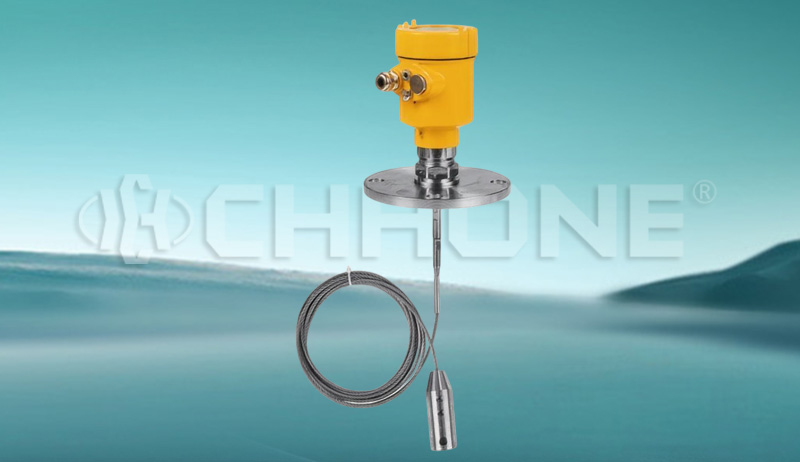
Choosing the correct GWR for an application requires looking past the standard temperature and pressure ratings. The most critical, and often mishandled, specification is the probe selection relative to the dielectric constant (εr) and the physical behavior of the medium. For instance, a coaxial probe is generally the most robust choice for low-dielectric media and aggressive chemical service because it confines the electromagnetic field entirely within the outer tube, shielding the measurement from tank internals and turbulence. However, coaxial designs can be susceptible to clogging in highly viscous or crystallizing media. Conversely, a single rigid rod is easier to clean but requires a higher minimum dielectric constant and careful installation to prevent the probe from touching the tank wall or internal structures. Flexible cable probes offer an economical solution for tall silos or sumps, but they demand a weighted tensioning system to keep the cable taut; a slack cable will create erratic reflections and signal loss. CHHONE’s engineering consultation process prioritizes these nuances—evaluating not just the fluid’s dielectric constant, but also its coating tendencies, the presence of agitation, and the specific geometry of the mounting nozzle—to prevent the all-too-common scenario of a technically “in-spec” gauge failing within weeks of commissioning.
Application Realities: Where GWR Proves Its Worth
The true value of a well-engineered guided wave radar becomes evident in processes where reliability is non-negotiable. In the petrochemical sector, GWR is frequently deployed in interface measurement applications—such as separating oil from water in a separator vessel. Because the technology can distinguish between two distinct dielectric layers, it provides a continuous interface reading that is far more stable than traditional float-based systems. In the power generation industry, particularly in flue gas desulfurization (FGD) absorber towers, the slurry presents a nightmare scenario of high solids content, scaling, and persistent foam. While non-contact radar may suffer from signal attenuation through the dense foam layer, a GWR with a suitable coaxial or rigid probe can maintain a reliable echo, provided the probe material and insulation are chosen to resist the abrasive and corrosive slurry. Similarly, in chemical reactors with aggressive solvents or high temperatures up to 450°C (842°F), the ability to specify specialized probe coatings like PTFE or PEEK, along with high-pressure flanges, allows GWR to operate where ultrasonic and capacitance technologies fail.
The CHHONE Distinction: Manufacturing with Field Perspective
Wuxi CHHONE Scientific Instrument Co., Ltd. (part of Hangyi Group) did not emerge from a vacuum of theoretical design. Founded in 2014 and operating from a base of extensive process automation experience, CHHONE has built its manufacturing ethos around the specific pain points of plant maintenance engineers. The company’s guided wave radar portfolio is backed by a comprehensive suite of certifications—including explosion-proof ratings (Exia/Exd), metrology certificates, and EAC compliance—that are not merely wall decorations but essential prerequisites for operating in hazardous zones and ensuring trade-relevant accuracy . Beyond certifications, the CHHONE advantage is structural: the company maintains a full in-house ecosystem for level, flow, pressure, and water quality analysis. This cross-disciplinary manufacturing capability means that the sealing technology used in a GWR flange is informed by the same high-pressure standards applied to their pressure transmitters, and the signal processing is consistent with their broader radar and ultrasonic lines. For the end user, this translates to a level gauge that arrives factory-calibrated, with a local support network capable of troubleshooting application issues—not just returning a replacement unit under warranty. In an industry where a single day of unplanned downtime in a tank farm can cost tens of thousands of dollars, partnering with a Guided Wave Radar Level Gauge Manufacturer that understands the difference between a specification and a solution is not just smart procurement; it is operational insurance.