Radar Level Transmitter Manufacturer CHHONE: Why More Applications Are Moving to Radar When Ultrasonic Hits Its Limits
In industrial level measurement, ultrasonic technology has earned its place in a vast range of routine applications thanks to its non-contact principle and low cost. But when conditions turn harsh—heavy steam, thick foam, media with very low dielectric constants, or vigorous agitation inside the tank—the acoustic signal weakens quickly and measurement becomes unreliable. This is exactly where the radar level transmitter proves its worth. It uses electromagnetic waves instead of sound, making it virtually immune to temperature, pressure, steam, and vacuum conditions, and delivering stable level data where ultrasonic simply cannot cope. As a Radar Level Transmitter Manufacturerwith in-house development and production capability, CHHONE has added radar technology to its portfolio to offer a more durable measurement option for chemical storage, oil and gas inventory, water treatment, and other demanding scenarios. The following sections examine the technology, the selection logic, the installation essentials, and the manufacturing capabilities behind CHHONE's radar offering.
What Makes Radar Level Transmitters Fundamentally Different
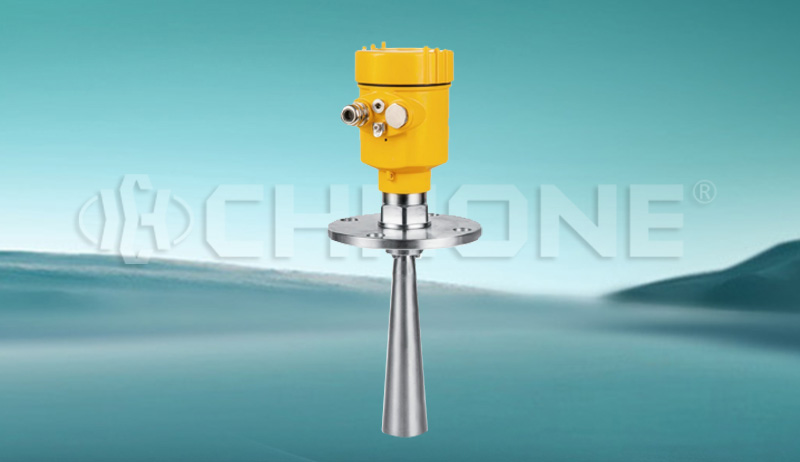
A radar level transmitter works on a principle similar to ultrasonic, but the medium is entirely different. The sensor emits high-frequency electromagnetic pulses toward the liquid surface. These waves travel through the air at the speed of light, reflect off the medium surface, and return to the antenna. The instrument calculates distance from the round-trip time and derives the level by combining that distance with the known tank height. What really determines measurement success is the dielectric constant of the medium—a measure of how strongly a material interacts with an electromagnetic field. Water has a high dielectric constant, producing a strong, clean reflection. Certain hydrocarbons or plastic granules have very low dielectric constants, yielding weak echoes that place greater demands on the instrument's signal processing capability.
Compared with ultrasonic, radar's core advantage is that electromagnetic waves do not depend on air as a propagation medium. Ultrasonic cannot travel through a vacuum and attenuates severely in steam, foam, or high-dust environments. Radar waves can penetrate these interferences and remain stable under condensation, steam, rapid temperature swings, or pressure fluctuations. In addition, radar beam angles are typically narrower and the energy more concentrated, giving better directivity in narrow vessels or tanks with internal obstructions and producing fewer false echoes. For measuring low-dielectric media or handling complex conditions involving agitators and heating coils, radar is often the more reliable choice than ultrasonic.
What Really Matters When Selecting a Radar Level Transmitter
Faced with radar level transmitters operating at different frequencies from 26 GHz to 80 GHz, the key to selection is not chasing the highest frequency or the longest range, but matching the instrument's characteristics to the physical processes actually occurring inside the tank.
Frequency selection must serve the application.80 GHz radar has shorter wavelength, narrower beam angle, and higher accuracy, making it suitable for small tanks, narrow openings, or locations with many internal obstructions. But higher frequency is not universally better: in heavy steam or thick foam, lower frequencies (such as 26 GHz or 6 GHz) penetrate more effectively with less signal attenuation and often yield a more stable echo. For installations using stilling wells or bypass chambers, the signal geometry of 6 GHz radar often matches better. CHHONE confirms the customer's medium properties, tank structure, and process conditions before shipment, avoiding the common mistake of assuming "higher frequency is always better."
Dielectric constant determines whether you can "see" the surface.Media with a dielectric constant below roughly 2—certain solvents, light oils, some plastic granules—produce extremely weak echoes and require instruments with stronger signal processing and higher transmit power. If the dielectric constant is too low or the medium absorbs electromagnetic waves, guided-wave radar or another measurement principle may need to be considered. This parameter must be confirmed with the medium supplier or process engineer during selection; it cannot be assumed from experience.
Process connections and certifications cannot be fixed later.Tank-top flange specifications, thread sizes, and standpipe lengths are mechanical interfaces that become costly to modify on site once fixed. For hazardous areas, the instrument's explosion-proof certification level must match the area classification. CHHONE's radar product line covers both routine process and explosion-proof requirements, with interface and certification verification completed at the order stage to reduce field rework.
Installation Determines Whether the Instrument Survives in Service
Although radar level transmitters tolerate harsh conditions better than ultrasonic, incorrect mounting location can still cause fluctuating readings, lost echoes, or measurement deviation.
Avoid everything that generates echoes.Agitator blades, heating coils, ladders, reinforcing ribs, inlet nozzles—all of these internal structures reflect radar waves. If the echo strength approaches that of the real liquid surface, the instrument may lock onto the wrong target. The mounting point should be kept as far as possible from these interference sources, and no fixed obstacles should exist within the beam path. If internal structures cannot be avoided, false echo suppression (sometimes called "echo learning") must be performed during commissioning so the instrument learns which echoes are fixed interference and which represent the real surface.
The antenna must aim at the liquid surface.This does not mean the housing must be level—it means the antenna centerline must be perpendicular to the liquid surface. An unlevel tank-top flange or a tilted standpipe will deflect the beam and reduce echo strength. For solids level measurement, if the material has a large angle of repose, a universal joint may be needed to adjust the angle so the beam is as perpendicular to the material surface as possible.
Blind zone management is the last line of defense.A radar antenna has a short blind zone near the face where measurement is not possible, and the maximum fill level must remain outside this distance. The "empty tank distance" and "full tank position" entered during commissioning must be based on actual tank dimensions, not theoretical values. If residual material or sediment exists at the tank bottom, the zero point should be adjusted according to the effective measurement range rather than copied from a template.
Outdoor installation details are easily overlooked.Direct sunlight can raise the housing temperature far above ambient, accelerating long-term aging of electronic components. If steam or rainwater enters through the cable entry, the consequences range from signal anomalies to complete instrument failure. CHHONE's radar products meet outdoor and humid-environment requirements in terms of ingress protection, but correct cable bending direction and proper sealing gland selection still depend on proper field installation practice.
CHHONE's Position as a Radar Level Transmitter Manufacturer
CHHONE's entry into radar level transmitters is not simply a matter of adding a category to the product catalog. For customers already using CHHONE's ultrasonic and wireless products, the radar option fills the capability gap that ultrasonic leaves in harsh conditions. When steam, foam, or low-dielectric media make acoustic measurement unreliable, customers do not need to find another supplier and rebuild a technical relationship—they gain an alternative within the same quality control system and technical support framework.
Product positioning serves real needs.CHHONE's radar level transmitters cover standard ranges and process connections, with output options supporting 4–20 mA and digital communication for integration with existing PLC or DCS architectures. For hazardous areas, the product line includes models compliant with classified-location requirements. The non-contact principle means no wear parts and no contamination risk, reducing the frequency of maintenance intervention in chemical and oil storage applications.
Application scenarios complement ultrasonic.In water treatment, ultrasonic remains lower cost and simpler to install for open basins and atmospheric tanks. But when a tank has steam heating or the medium is a low-dielectric chemical, radar becomes the more practical choice. In oil inventory measurement, radar's response to level changes is unaffected by medium density and viscosity, making it suitable for crude oil, diesel, and various solvent tanks. CHHONE's technical team helps customers judge at the selection stage whether ultrasonic is sufficient for the application or whether radar is needed—rather than simply pushing the most expensive product.
Manufacturing capability is the foundation for long-term partnership.Located in Wuxi and established in 2014, CHHONE has accumulated manufacturing and quality control experience in environmental monitoring and process instrumentation. The introduction of radar level transmitters continues the same incoming inspection, assembly testing, and factory calibration processes. For customers requiring batch deployment or long-term spare parts supply, the manufacturer's stability and responsiveness matter as much as product specifications. CHHONE's positioning is not to build the most eye-catching model on a datasheet, but to be the company whose instruments keep running on site—and whose phone gets answered when something needs attention.
For engineers evaluating level measurement solutions, ultrasonic and radar are not mutually exclusive choices but tools for different conditions. As a manufacturer offering both technologies, CHHONE can recommend based on actual medium properties, tank conditions, and maintenance capability rather than leaving customers to learn by trial and error.