The Certification Is Just the Beginning: What Separates a True Explosion-Proof Radar Level Transmitters Manufacturer
In hazardous process environments, an explosion-proof rating is not a feature—it is a license to operate. Every supplier in the level measurement market can print “Ex d” or “Ex ia” on a datasheet. What distinguishes a genuineExplosion-Proof Radar Level Transmitters Manufacturer from a certificate assembler is the depth of engineering that sits behind the ATEX or IECEx mark: the thermal management of the electronics, the material integrity of the housing, the barrier design that keeps energy contained, and the application knowledge that prevents a certified device from becoming an uncertified liability once it is bolted to a nozzle. CHHONE approaches explosion-proof radar level measurement not as a compliance checkbox, but as a system-level discipline that begins with circuit architecture and ends with on-site commissioning support.
The Engineering Reality Behind the Ex Mark
An explosion-proof radar level transmitter is designed to operate in atmospheres where a spark or excessive surface temperature could ignite flammable gases, vapors, or dust. The two dominant protection philosophies diverge sharply in practice. Intrinsic safety (Ex ia/ib) restricts the electrical and thermal energy available within the circuitry to levels incapable of ignition, even under fault conditions. Flameproof enclosure (Ex d) takes the opposite approach: it allows potentially igniting energy inside a rugged housing engineered to contain an internal explosion and prevent flame propagation to the surrounding atmosphere. Each approach imposes distinct constraints on the transmitter’s design. An intrinsically safe two-wire radar must operate on severely limited power budgets, which affects sampling rates and signal processing capability. A flameproof unit, while free from those power constraints, demands precision machining of flame paths, rigorous thermal analysis to ensure the enclosure surface never exceeds its T-class rating, and careful attention to cable entry sealing. CHHONE’s explosion-proof radar portfolio is built around this fundamental distinction, offering both protection concepts with circuitry and housings engineered to match—not merely repackaged general-purpose electronics.
Selection Beyond the Certificate Number
Choosing an explosion-proof radar transmitter for a chemical tank farm or a solvent storage facility requires reading the certificate with the same scrutiny as the specification sheet. The first trap is the zone classification. A device marked Ex d IIC T6 Gb is suitable for Zone 1 and Zone 2, but it cannot be installed in a Zone 0 location where an explosive atmosphere is present continuously or for long periods. Intrinsically safe Ex ia apparatus, which permits two simultaneous faults without compromising safety, is the appropriate choice for Zone 0 service. The second trap is the temperature class. T6 means the maximum surface temperature under fault conditions will not exceed 85°C. In processes involving heated media or steam-traced tanks, the transmitter’s own process temperature rating must be reconciled with the T-class—often requiring an extended neck or a separation between the antenna flange and the electronics housing to prevent heat migration into the flameproof compartment. The third, and most frequently overlooked, consideration is the antenna and process wetted materials. The explosion-proof housing protects the electronics; it does nothing for the antenna if the process medium is hydrochloric acid vapor or caustic slurry. PTFE lens antennas or encapsulated rod designs are often necessary to preserve both measurement integrity and the mechanical safety of the pressure boundary.
Where Explosion-Proof Radar Earns Its Keep
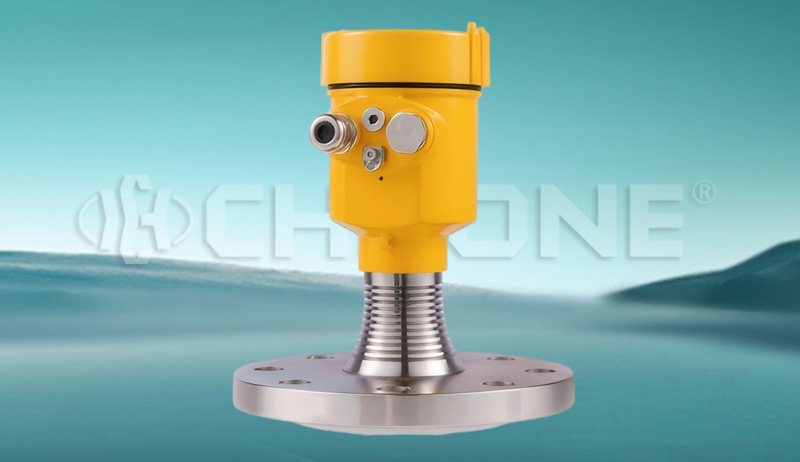
The applications that justify the cost and complexity of explosion-proof radar are those where failure carries consequences beyond a missed reading. In petrochemical tank gauging, 80 GHz non-contact radar with Ex d certification provides continuous level data on volatile hydrocarbon storage without the maintenance burden of float-based mechanical systems, while its narrow beam angle tolerates the internal obstructions common in older tanks. In chemical reactors handling flammable solvents, the transmitter must not only survive the atmosphere outside the vessel but also withstand the process conditions inside—elevated temperatures, aggressive vapors, and potential foam layers that can distort weaker signals. CHHONE’s explosion-proof radar units are deployed in precisely these service conditions, with configurations that address the full chain of safety: certified housing, appropriate antenna sealing, correct cable gland specification, and signal outputs compatible with the plant’s safety instrumented system. The company’s manufacturing scope extends beyond level instrumentation to pressure, flow, and water quality analysis, which means the sealing and material expertise applied to a radar flange is informed by the same standards used across a broader instrumentation portfolio—a cross-disciplinary rigor that a single-product assembler cannot easily replicate.
The Manufacturer’s Role After the Sale
The final measure of an explosion-proof radar manufacturer is not the paperwork that ships with the instrument, but the support that accompanies its installation. A certified transmitter installed on a nozzle that is too short, or with a cable entry that bypasses the flame path, or with a grounding arrangement that violates the barrier circuit, is no longer compliant—and the certificate on the wall will not protect the plant during an audit or an incident. CHHONE’s approach to explosion-proof level measurement includes application review before the order is confirmed and commissioning guidance after the shipment arrives, ensuring that the protection concept designed into the instrument is preserved through installation. For process engineers and procurement teams navigating the intersection of safety regulation and measurement performance, partnering with anExplosion-Proof Radar Level transmitters Manufacturerthat understands both sides of that intersection is not a procurement preference—it is a risk management decision.