Signal Integrity Over Specifications: How a Non-Contact Radar Level Measurement Factory Redefines Reliability
In industrial level measurement, non-contact radar makes a deceptively simple promise: know where the medium is without ever touching it. That promise is easy to keep in a clean water tank. It becomes a genuine engineering challenge in a steam-filled reactor, a dust-choked silo, or a storage vessel holding light hydrocarbons whose dielectric constant barely registers a reflection. At that point, the question is no longer whether a device uses radar—it is whether the Non-Contact Radar Level Measurement factory behind it truly understands every point of signal loss between the antenna and the echo-processing algorithm. CHHONE, a process instrumentation manufacturer operating since 2014, builds its non-contact radar portfolio around two dimensions that datasheets rarely address: the electromagnetic efficiency of the antenna design, and the ability of the echo algorithm to distinguish a real surface from the clutter that surrounds it.
The Physics That Separates a Reading From a Guess
Non-contact radar level measurement rests on a straightforward principle. The sensor emits a microwave signal toward the product surface and receives the reflected echo; frequency-modulated continuous wave (FMCW) technology then calculates distance from the frequency difference between the transmitted and received signals. Unlike ultrasonic devices, microwaves propagate through vacuum and their speed is virtually unaffected by temperature and pressure fluctuations, which gives radar a natural advantage in high-temperature, high-pressure, and vapor-laden environments. What actually determines whether a given non-contact radar can handle a specific application, however, is the dielectric constant (εr) of the medium. Water, with a dielectric constant above 10, returns a strong echo and permits measurement over considerable distances. Non-conductive liquids such as gasoline or toluene may have dielectric constants low enough that the reflected signal is feeble, and it is here that antenna gain, beam focusing, and algorithmic sensitivity become decisive rather than incidental.
Choosing the Right Non-Contact Radar: Five Questions That Matter More Than the Datasheet
Selecting a non-contact radar transmitter is an exercise in matching physics to process conditions, and the most common specification errors share a common root: treating the instrument as a commodity rather than an application-specific solution.
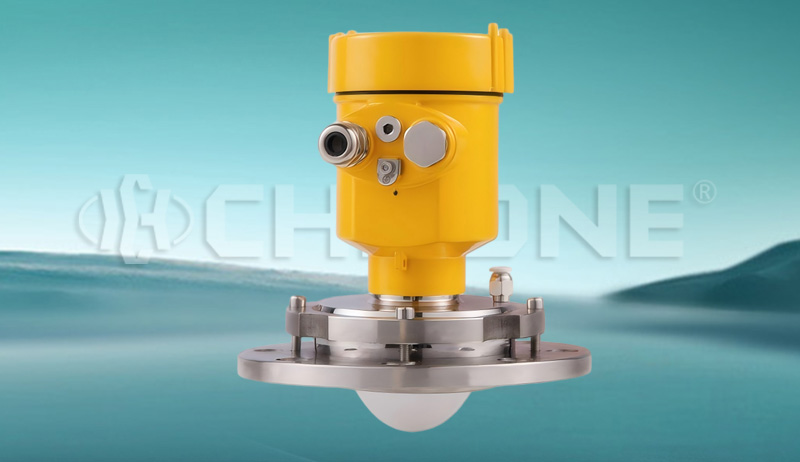
The first question is frequency and beam angle. Higher-frequency units, such as 80 GHz designs, produce a narrower beam that tolerates internal obstructions, narrow nozzles, and tall, slender silos far better than lower-frequency alternatives, because a tighter beam footprint reduces unwanted reflections from tank walls and agitators. The second is antenna material and sealing. A PTFE or PFA lens antenna may be essential in aggressive chemical service, while a stainless steel horn is often the more durable choice in abrasive solids. The third is process temperature and pressure at the antenna, not merely at the flange—heat migration into the electronics housing remains one of the leading causes of premature transmitter failure. The fourth is the presence of foam, condensation, or dust, each of which attenuates or scatters the returning signal and may call for a different frequency or a larger antenna. The fifth, and most frequently neglected, is the mounting geometry: a nozzle that is too long or too narrow can create ringing and multiple reflections that no amount of signal processing can fully overcome. CHHONE's application review process is structured around these five variables precisely because a non-contact radar that is technically "in specification" can still fail in the field when the antenna, the medium, and the mounting are not evaluated together.
Where Non-Contact Radar Proves Its Value
The applications that justify non-contact radar are those in which contact-based instruments would be compromised by the process itself. In the water and wastewater sector, non-contact radar provides continuous level data in open channels, wet wells, and clarifiers without the fouling and maintenance burden that affects submersible pressure sensors. In food and beverage processing, hygienic non-contact radar avoids product contact altogether, simplifying cleaning validation and reducing contamination risk. In mining and bulk solids handling, 80 GHz radar measures level in tall silos and crusher bins where dust clouds would defeat ultrasonic devices and where the angle of repose of the material creates an uneven surface that demands a focused beam. In chemical storage, non-contact radar handles aggressive liquids and vapors from outside the vessel, with explosion-proof housings available where the surrounding atmosphere requires them. CHHONE's manufacturing scope spans level, flow, pressure, and water quality analysis, which means the antenna sealing and material selection applied to a radar transmitter is informed by the same engineering standards used across a broader instrumentation portfolio—an advantage that single-product assemblers rarely possess.
The Factory's Role in the Field
The final measure of aNon-Contact Radar Level Measurement factoryis not the accuracy figure printed on the calibration certificate, but whether that accuracy survives installation. A transmitter mounted on a nozzle that is too short, aimed at an agitator blade, or configured with an empty-spectrum mapping that was never updated after the tank was filled for the first time will underperform regardless of its laboratory specifications. CHHONE's approach includes application engineering before the order is confirmed and commissioning guidance after shipment, ensuring that the instrument's signal processing is tuned to the actual vessel rather than to a generic factory default. For process engineers and procurement teams who understand that non-contact radar is a system-level decision rather than a component purchase, partnering with a factory that treats signal integrity as an engineering discipline—not a marketing claim—is the difference between a level transmitter that reports numbers and one that reports the truth.