Explosion-Proof Ultrasonic Level Meter Manufacturer: A Complete Guide to Selection, Installation, and CHHONE’s Capabilities
In hazardous industrial environments where flammable gases, vapors, or combustible dusts may be present, level measurement is not merely a matter of process efficiency—it is a critical safety function. An explosion-proof ultrasonic level meter is engineered to deliver accurate, non-contact measurement while eliminating the risk of ignition that could trigger a catastrophic event. As a specializedExplosion-Proof Ultrasonic Level Meter Manufacturer, CHHONE designs and produces instruments that combine certified safety with reliable performance for oil and gas, chemical processing, and other demanding sectors. This article examines the fundamentals of explosion-proof ultrasonic level meters, key selection criteria, proper installation practices, and the manufacturing strengths that distinguish CHHONE in the global market.
What Is an Explosion-Proof Ultrasonic Level Meter?
An explosion-proof ultrasonic level meter is a non-contact level measurement instrument designed for installation in classified hazardous areas. It operates on the time-of-flight principle: a piezoelectric transducer emits high-frequency acoustic pulses toward the material surface, and the instrument calculates the level by measuring the time required for the echo to return. Because the sensor never contacts the measured medium, it avoids the corrosion, contamination, and mechanical wear that affect contact-type instruments.
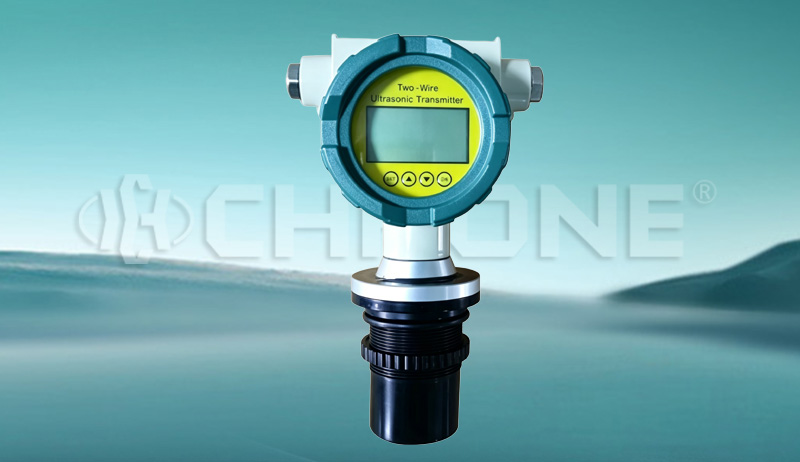
What distinguishes the explosion-proof variant is its protective housing and certified design. The enclosure is constructed to contain any internal spark or thermal event, preventing ignition of the surrounding explosive atmosphere. Common certification standards include Ex d (flameproof) and Ex ia (intrinsically safe) classifications, with compliance to ATEX, IECEx, or national equivalents. Typical construction features die-cast aluminum alloy housings, IP67 or higher ingress protection, and encapsulated electronics that resist moisture, dust, and corrosive vapors. Modern units also incorporate temperature compensation to correct for variations in the speed of sound, ensuring measurement stability as ambient conditions fluctuate.
How to Choose the Right Explosion-Proof Ultrasonic Level Meter
Selecting an appropriate instrument for a hazardous area requires careful evaluation of both safety certification and process conditions. As an experiencedExplosion-Proof Ultrasonic Level Meter Manufacturer, CHHONE advises customers to address several critical factors before specifying a model.
Certification and Area Classification.The first consideration is the hazardous area classification of the installation site. Different zones (Zone 0, 1, or 2 for gases; Zone 20, 21, or 22 for dusts) dictate the required protection concept. Intrinsically safe designs limit electrical energy to levels incapable of ignition, while flameproof enclosures contain internal explosions. The certification must match the specific gas group and temperature class of the environment. For oil and gas applications involving hydrocarbons, instruments rated for Ex d IIB T4 or higher are commonly specified.
Measurement Range and Application Conditions.The instrument’s range must exceed the maximum expected level with adequate margin. Standard explosion-proof ultrasonic meters cover ranges from 5 to 20 meters, with accuracy typically around ±0.25% to ±0.3% of full scale. The presence of steam, foam, heavy dust, or surface agitation can attenuate the acoustic signal and must be evaluated. For tanks containing volatile liquids that generate vapor layers, sensors with advanced echo processing and automatic gain control are preferable. The beam angle also matters: a narrower beam provides more precise targeting in tall, narrow vessels and reduces interference from internal structures such as ladders or agitators.
Output, Communication, and Integration.Compatibility with the plant’s control architecture is essential. Most explosion-proof ultrasonic level meters provide a 4–20 mA analog output for legacy PLC systems, while digital protocols such as RS485 Modbus or HART enable richer diagnostics and remote configuration. The instrument’s power supply requirements, cable entry type, and hazardous-area wiring practices must also be verified against site standards.
How to Install and Use Explosion-Proof Ultrasonic Level Meters Safely
Proper installation is especially critical in hazardous areas, where both measurement performance and safety compliance depend on correct mounting and wiring practices.
Mounting Position and Orientation.The sensor should be mounted perpendicular to the material surface, with a tilt angle ideally not exceeding 3 degrees. It must be positioned away from inlet streams, agitators, and internal obstructions that could generate false echoes. The transducer face should protrude beyond the end of any mounting nozzle to avoid signal reflection from the nozzle walls. In tanks with conical or dished bottoms, installation near the center helps maintain a measurable signal at low levels. For outdoor installations, a sunshade or weather cover protects the housing from direct sunlight and precipitation.
Electrical Installation and Safety Practices.All wiring must be performed with the power disconnected. Shielded twisted-pair cable is recommended, with the shield grounded at the instrument end only to prevent ground loops. Signal cables should be routed separately from high-power or variable-frequency drive cables to minimize electromagnetic interference. For flameproof enclosures, the cable gland must be tightened to maintain the integrity of the protection concept, and the cover must never be opened while the circuit is energized in a hazardous area.
Configuration and Commissioning.Before placing the instrument into service, the empty and full distances, blind zone, and output scaling must be configured according to the actual tank dimensions. The blind zone—the minimum distance below the transducer where measurement is not possible—must be set so that the maximum fill level never enters this region. Damping and filtering parameters help stabilize readings in applications with surface movement. CHHONE instruments support local configuration via an integrated display or remote access through digital communication, allowing technicians to complete commissioning efficiently while observing all safety protocols.
CHHONE: A Reliable Explosion-Proof Ultrasonic Level Meter Manufacturer
CHHONE has built its reputation as anExplosion-Proof Ultrasonic Level Meter Manufacturerby combining certified product design with practical engineering support and consistent manufacturing quality.
Product Design for Hazardous Environments.CHHONE’s explosion-proof ultrasonic level meters feature robust aluminum alloy housings engineered to withstand the mechanical and environmental stresses of industrial service. The instruments carry explosion-proof certification suitable for use in zones where flammable gases are present, providing operators with confidence in safety compliance. The non-contact measurement principle eliminates wear and contamination, extending service life and reducing maintenance intervention in difficult-to-access locations. Output options including 4–20 mA and RS485 ensure straightforward integration with PLC and DCS architectures, enabling real-time monitoring and automated control.
Proven Applications in Critical Industries.CHHONE instruments are deployed in applications where failure is not an option. In the oil and gas sector, they monitor crude oil storage tanks, diesel inventories, and chemical processing vessels where accurate level data supports both operational efficiency and safety compliance. In chemical plants and wastewater treatment facilities, the non-contact design resists corrosive vapors and aggressive media that would quickly degrade contact sensors. Additional applications include offshore platforms, petroleum transportation facilities, and environmental monitoring systems where reliable hazardous-area measurement is essential.
Manufacturing Commitment and Customer Support.As a dedicated manufacturer, CHHONE maintains rigorous quality control throughout the production process, from component selection and transducer assembly to final calibration and testing. Each instrument is verified against performance specifications before shipment. The company backs its products with responsive technical support and application expertise, helping customers navigate the complexities of hazardous-area installation and configuration. By choosing CHHONE, businesses gain not only a certified instrument but a manufacturing partner committed to safety, reliability, and long-term service in the most demanding industrial environments.